Research Posts
Research Posts feature in-depth explanations about a topic of your choice that relates to our online lives. To learn about your topic you’ll find and cite at least four high-quality sources, and you’ll be incorporating and properly attributing media that is licensed for reuse. You’ll also have a variety of posting formats to choose from.
The Goal
The goal of a research post is to conduct research about a topic that relates to our online lives, then share your knowledge about it in an effective format online.
Essential Skills
When you complete this assignment, you’ll be demonstrating the Essential Skills listed below. Skills in bold will be particularly emphasized while assessing your work.
- Accurately assessing requirements
- Citing, attributing, and respecting intellectual property
- Composing with clarity and focus
- Comprehending, analyzing, interpreting, and making meaning of material
- Determining relevance
- Expressing yourself effectively through visual media
- Identifying key concepts
- Managing, analyzing, and synthesizing multiple streams of information
- Promoting credibility
- Putting parts of the product in logical/productive order
- Revising based on feedback and reflection
- Selecting and discerning appropriate media to generate self-directed inquiry
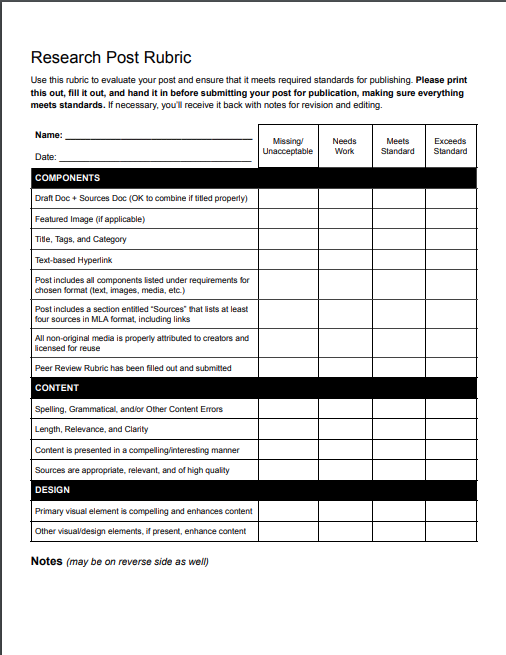
Rubric
Use this rubric to ensure that your work meets standards. Please be sure to print it, fill it out, and hand it in before submitting your blog post for review.
Note that some repeating standards are presented in shortened form to preserve space. Please refer to their descriptions in earlier rubrics for full descriptions.
How It Works
APPLICATION FORM- Choose a topic of interest (see potential topics below)
- Locate at least 6 sources that relate to the topic into a Google Doc
- Choose an appropriate post format
- Submit a Project Application and get topic and format approval
- Review your sources and learn about your topic
- Choose and properly cite (in MLA format) four high-quality sources for inclusion in your post
- Create your post based on format requirements (all posts should include sources, tags, and the “Research” category)
- Evaluate your post using the publication rubric, making sure that all standards are met
- Get rubric feedback from a peer
- Fill out and submit your completed rubric
- Submit post for publication online
- Get teacher feedback and revise your post as necessary
Acceptable Formats
All formats listed on the post formats page are acceptable.
Research Topics
Your research topic must relate in some way to our online lives. It will serve as an introduction to classmates and blog visitors who are unfamiliar with the topic, and provide them with resources that they can use to find out more for themselves. Choose a topic to research that you’re passionate about, then make sure that you find high-quality articles to back up your findings and promote credibility.
While you are welcome to choose any appropriate topic, there are some ideas to get you started below. Note that some of these topics we study as a class, but there is always more to learn and explore. Topics that aren’t part of the regular class curriculum are also wonderful opportunities to further educate ourselves and the community.
Once you’ve narrowed your list of possible topics down to two or three that interest you, use your search skills to do some preliminary research, and then choose the one that you feel most passionate about.
Research Tips
- Look for high-quality sources that have conducted research, created solid journalistic work, or provided other data to support the information they provide. Credibility is important, here.
- Use the evaluation rubric to carefully scrutinize the quality of each site you consider.
- Keep notes in a Google Doc or another easy-to-access document so that you can find and retrieve information when you need it.
Potential Project Topics
- Big Data
- Building Online Communities
- Creative Commons Licensing
- Dark Patterns
- Defending Against Online Scams and Hoaxes
- Digital Permanence (“Tattoos”)
- Disintermediation
- Diversity in Technology
- Effective Online Research
- Equity in Access to The Internet
- Filter Bubbles
- Hacktivism
- Healthy Online Relationships
- How Behavior is Manipulated Online
- How Screens Affect Us
- How Students Can Use Social Media
- Identifying and Combatting Fake News
- Internet Access In Other Cultures
- Machine Learning / Artificial Intelligence Online
- Managing Your Online Presence
- Net Neutrality
- Online Activism
- Online Privacy
- Open Platforms vs. Closed Platforms/Ecosystems and “Walled Gardens” Online
- Plagiarism and the Internet
- Remix Culture
- Smartphones’ Impact on Society
- Staying Safe and Secure Online
- The Open Source Movement
- The Origins of the Internet
- The Psychology of Online Engagement
- Using Social Media to Influence Elections
- Wikileaks and Edward Snowden